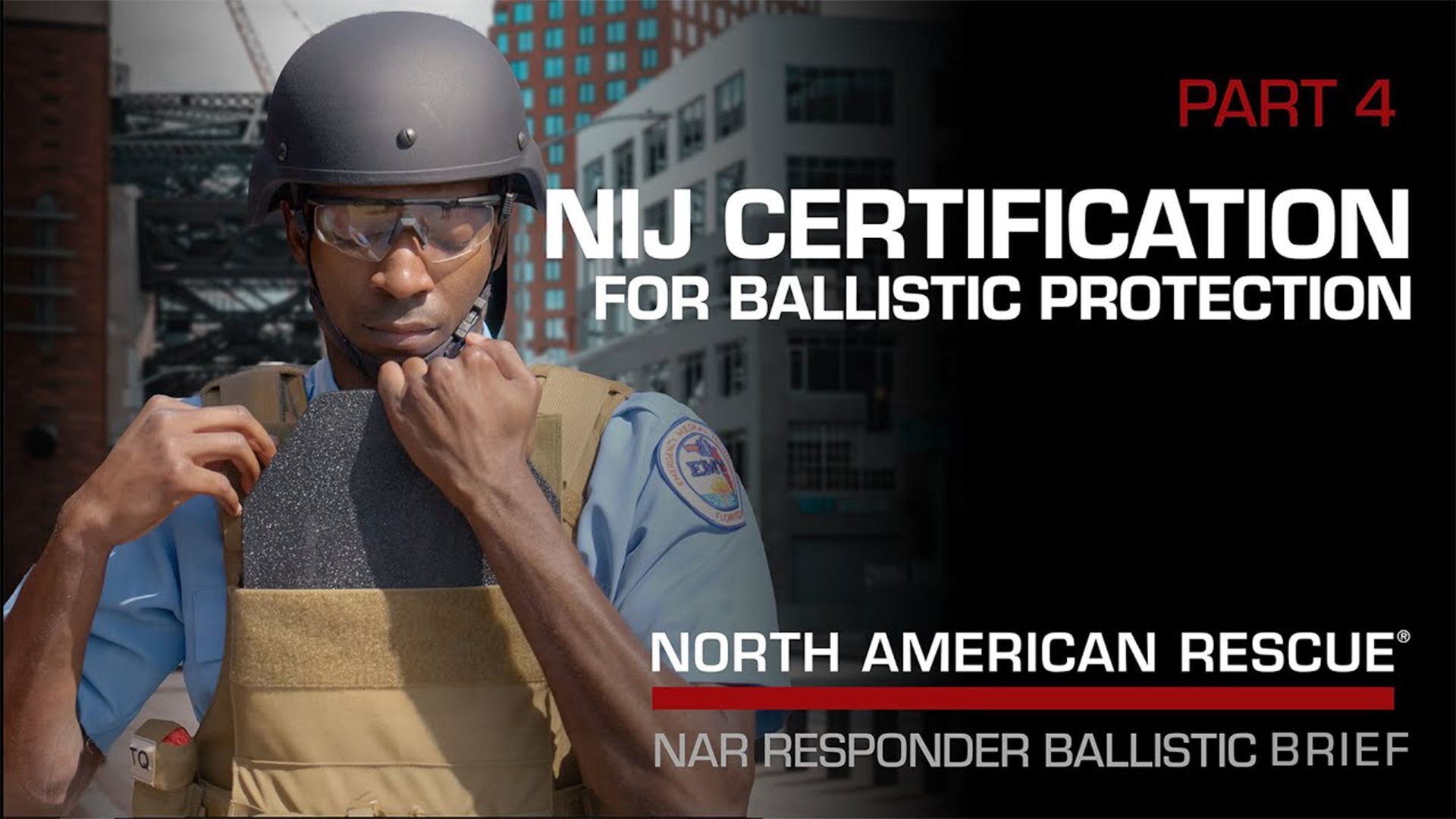
In this next section, we're going to talk about the National Institute of Justice, also known as the NIJ, which is the governing authority on body armor. They set the standards and testing protocols on how body armor is tested and the different levels. We're going to talk about the key terms used in body armor testing, and then we're going to explain the various levels within the NIJ body armor protocols.
The NIJ provides guidance for body armor. It sets the minimum performance standards and also lays out the testing protocols for body armor. The current NIJ standard is 01010.07, and you can refer to this as the ballistic resistance of body armor. It was published on July 8, 2025.
It's also important to understand that armor testing is voluntary. It's not required. If an armor package goes through the NIJ testing, it must be performed at an NIJ-certified laboratory. The NIJ publishes a list of certified products, also known as the compliant products list or CPL. So it's also important to make sure that your package is on the NIJ CPL list.
Independently tested armor is not considered NIJ certified. Armor that's NIJ certified will clearly state so on the armor label. Don't be fooled by language such as "it's been tested at an independent laboratory" or "tested via NIJ protocols" or "in compliance with." The label will clearly state its NIJ certification, and the package will be on the CPL list.
Armor Testing
Some key terms for ballistic data information:
- Aerial density or ad: which is simply the weight of a 12 inch by 12 inch swatch of the armor panel.
- Back face signature: which is the greatest indentation into the ballistic clay, caused by a non-perforating bullet.
- Ballistic limit: AKA V50, the velocity at which the bullet is expected to perforate the armor 50% of the time.
- Perforation: when a projectile passes through the armor.
- Standalone: in reference to rifle plates is a hard armor plate designed to function independently of soft armor.
- In conjunction with (ICW): a combination of hard and soft armor panels designed to increase ballistic protection. With in conjunction armor, it's important to remember that the hard armor and the soft armor panels used in the testing through the NIJ must be together in order to achieve that level of performance.
- Single hit: tested to protect against a single round strike.
- Multi hit: or multis strike means it's tested to protect against multiple strikes.
So let's talk about NIJ testing. What do they do? How do they ensure that these products perform? There are several different factors that go into the NIJ testing.
Number one is perforation. Obviously, we have to ensure that the bullet does not perforate the armor package. Number two is what's referred to as back face signature, as we explained earlier with soft armor, whenever a projectile strikes the soft armor package, it catches, but then deforms in the direction of travel of the energy, which means into your body.
The NIJ has set up what it refers to as passing or acceptable back face data, which is 44 millimeters or about 1.73 inches. Now, this is important to ensure that your back face data is as low as possible because that directly translates to blunt force trauma to the human body.
And then the third and final testing that they do is referred to sometimes as the V50 or ballistic limit, and essentially that just translates into the maximum amount of velocity, how fast they can push a bullet, and the soft armor still stops and performs as expected to. In addition, soft armor is also tested for durability through environmental testing, the soft armor is exposed to extreme heat, extreme cold, moisture, and it’s also tumbled in a specialized dryer to simulate usage over years and years. And finally, hard armor, as we refer to before, rifle plates are affixed to a pendulum and then dropped against a very hard surface in a very scientific, controlled manner to ensure there's no cracking and that the plate will remain durable.
NIJ Levels
Soft Armor
The NIJ offers several different levels of armor protection. For soft armor protection, the standard levels are HG1 and HG2. The National Fire Protection Agency 3000 document for active shooter recommends a minimum of HG2 protection. The International Association of Firefighters also recommends a minimum of HG2 for active shooter or hostile events.
Here at North American Rescue, we start with HG2 as the foundation of our soft armor products. Because it provides the maximum level of protection for the end user, it's going to protect you all the way from 9 mm, which is the most common pistol round used in violence, all the way through 44 Magnum.
The NAR HG2 Soft armor package has been additionally special threat, tested for a variety of different handguns:
- 9 mm 127GR SXT
- 40 CAL 165 GR GDHP
- 5.7 x 28MM SS195/7
- FRAG 2GR to 64 GR
NIJ HG2 provides the highest level of protection against a pistol threat. In order to protect against rifles, we have to move into hard or rigid plates, which are categorized as RF1 or RF3.
Hard Armor
RF1 hard armor is designed to stop the 5.62 X 51MM or 308. Most, but not all, RF1 hard armor on the market will also stop standard 5.56 millimeter ball ammunition. The RF2 rating is generally meant to address the 5.56 millimeter M855 round, commonly referred to as the green tip, which requires a steel or ceramic front face to prevent perforation. An NIJ RF2 plate is designed to stop against a true 30 caliber round or a 30 odd six round, which is very uncommon.
An RF3 plate is not the answer...
The highest level of body armor, an RF2, is often not the right answer. Body armor is a balance. It's a balance between weight, comfort, and cost. If you can't do your job in the gear, it's the wrong gear. The data is not there to support routine wear of an RF2 plate. Because of that, a more balanced approach would be North American Rescue's RF1 plate. That is also a special threat tested for some of the more common threats. We spent a lot of time and a lot of prototyping and development to make sure that we were maximizing coverage both front and laterally.
It had adjustability so that it's going to fit 80% of the population the best versus older-style rescue task force vests. And then, more importantly, you can still do your job. Job duties and functions by paramedics and firefighters require a different set of movements than law enforcement. And so we had to adjust the profile of this vest to ensure that you can still do your job while staying protected.
New Threat Levels (Released July 2025)
HG1 = formerly Level II under standard 01010.06, HG2 = formerly Level IIIA under standard 01010.06, RF1 = formerly Level III under standard 01010.06, RF2 = formerly Level IV under standard 01010.06